Butch Femme Planet  

Go Back   Butch Femme Planet > HEALTH: BODY, MIND, SPIRIT > Support: Abuse, Addiction, Coping

Reply
 
Thread Tools Display Modes
Old 09-10-2020, 01:30 PM   #1
Apocalipstic
Pink Confection

How Do You Identify?:
Femme
Preferred Pronoun?:
She, Her, Ma'am
Relationship Status:
Dating Myself
 
Apocalipstic's Avatar
 

Join Date: Nov 2009
Location: Nashville
Posts: 4,266
Thanks: 17,195
Thanked 11,358 Times in 2,838 Posts
Rep Power: 21474857
Apocalipstic Has the BEST ReputationApocalipstic Has the BEST ReputationApocalipstic Has the BEST ReputationApocalipstic Has the BEST ReputationApocalipstic Has the BEST ReputationApocalipstic Has the BEST ReputationApocalipstic Has the BEST ReputationApocalipstic Has the BEST ReputationApocalipstic Has the BEST ReputationApocalipstic Has the BEST ReputationApocalipstic Has the BEST Reputation
Default

Quote:
Originally Posted by dark_crystal View Post
Yesterday was two weeks since the incident and I still get nausea and chills at the thought of entering the library.

I am improving in that the physical pain had ended by this past weekend. The doctor said that my hypermobility disorder causes emotional distress to trigger "somatosensory amplification," so my usual hip, neck, and shoulder pain were cranked up to an immobilizing extent in the days immediately following the incident.

BUT i can't read any books! The thought of just opening the library app on my phone gives me palpitations and clammy hands.

On the administrative side of things, HR has given me permission to do a written warning, IF my boss approves, but they do not feel moving her is warranted.

I typed up the corrective action form and now i am waiting for my boss to approve it. This is by no means guaranteed.

My primary doctor's recommended course of treatment following this trauma was to take a month off of work and use that time to attend therapy three times per week, and do Pilates at least two times per week.

I will be doing two virtual therapy sessions and will begin weekly in-person EMDR sessions tomorrow. I am seeing my psychiatrist next Friday. I am also seeing an autism specialist and I have committed to a three month Pilates package (expensive af but literally the only exercise allowed with hypermobility)

The Pilates is supposed to strengthen my muscles to the point where they are passively stabilizing my joints. Hypermobility plus my current state of emaciation means that my muscles are actively holding my joints together, and this increases the adrenaline in my bloodstream, which manifests as anxiety.

This anxiety is all chemical and just floating around in there, but it gets added to my PTSD-related anxieties and supposedly that is why i had such an "extreme" reaction to this particular trauma, according to my primary care doctor (my therapist does not consider my reaction extreme, and she was horrified to hear my bully had been given my job)

The thing is, I couldn't start Pilates until yesterday, due to pain, and it will be August 18 before my therapist can add the second virtual session, so I will not actually be in compliance with my treatment plan until the last two days of my month off. I am seeing her again on Friday and i will ask her if she can extend my recommended leave to September 21.

The EMDR therapist's office is near my parents' house, and the efficiency tyrant in me says to kill two birds with one stone and knock out my weekly visit with them immediately following therapy.

Am i correct in my understanding that i will come out of EMDR in a fairly raw state and not be in any condition to deal with my parents, who are implicated in my ongoing trauma?
I am super 100% raw when I get out of EMDR. Not a good time to visit triggers.
__________________
Apocalipstic is offline   Reply With Quote
The Following 3 Users Say Thank You to Apocalipstic For This Useful Post:
Old 09-13-2020, 11:00 AM   #2
dark_crystal
Infamous Member

How Do You Identify?:
jenny
Preferred Pronoun?:
babygirl
Relationship Status:
First Lady of the United SMH
 
dark_crystal's Avatar
 

Join Date: Jan 2010
Location: Houston, Texas
Posts: 5,445
Thanks: 1,532
Thanked 26,548 Times in 4,687 Posts
Rep Power: 21474857
dark_crystal Has the BEST Reputationdark_crystal Has the BEST Reputationdark_crystal Has the BEST Reputationdark_crystal Has the BEST Reputationdark_crystal Has the BEST Reputationdark_crystal Has the BEST Reputationdark_crystal Has the BEST Reputationdark_crystal Has the BEST Reputationdark_crystal Has the BEST Reputationdark_crystal Has the BEST Reputationdark_crystal Has the BEST Reputation
Default

Quote:
Originally Posted by Apocalipstic View Post
I am super 100% raw when I get out of EMDR. Not a good time to visit triggers.
Yep. I tried it and had a meltdown in the car as soon as we left my parents'
__________________
dark_crystal is offline   Reply With Quote
The Following 3 Users Say Thank You to dark_crystal For This Useful Post:
Old 02-18-2021, 11:59 AM   #3
dark_crystal
Infamous Member

How Do You Identify?:
jenny
Preferred Pronoun?:
babygirl
Relationship Status:
First Lady of the United SMH
 
dark_crystal's Avatar
 

Join Date: Jan 2010
Location: Houston, Texas
Posts: 5,445
Thanks: 1,532
Thanked 26,548 Times in 4,687 Posts
Rep Power: 21474857
dark_crystal Has the BEST Reputationdark_crystal Has the BEST Reputationdark_crystal Has the BEST Reputationdark_crystal Has the BEST Reputationdark_crystal Has the BEST Reputationdark_crystal Has the BEST Reputationdark_crystal Has the BEST Reputationdark_crystal Has the BEST Reputationdark_crystal Has the BEST Reputationdark_crystal Has the BEST Reputationdark_crystal Has the BEST Reputation
Default

PLOT TWIST: Snowpocalypse

Well this has been a huge setback. Anyone else?

About 48 hours after my body accepts that the cold and dark is really over i am going to fall apart.

See ya'll Saturday
__________________
dark_crystal is offline   Reply With Quote
The Following 2 Users Say Thank You to dark_crystal For This Useful Post:
Old 03-08-2021, 01:25 PM   #4
JustLovelyJenn
Senior Member

How Do You Identify?:
Femme
Preferred Pronoun?:
She/her
Relationship Status:
That's Need to Know
 
JustLovelyJenn's Avatar
 

Join Date: Nov 2009
Location: Aberdeen, WA
Posts: 4,478
Thanks: 12,464
Thanked 13,991 Times in 3,684 Posts
Rep Power: 21474857
JustLovelyJenn Has the BEST ReputationJustLovelyJenn Has the BEST ReputationJustLovelyJenn Has the BEST ReputationJustLovelyJenn Has the BEST ReputationJustLovelyJenn Has the BEST ReputationJustLovelyJenn Has the BEST ReputationJustLovelyJenn Has the BEST ReputationJustLovelyJenn Has the BEST ReputationJustLovelyJenn Has the BEST ReputationJustLovelyJenn Has the BEST ReputationJustLovelyJenn Has the BEST Reputation
Default

It's been a year since I left a very toxic relationship.

It is by no means the longest relationship I have ever had, and yet... the 6 months I spent with this human did more damage than any one thing in the past 38 years.

He is not the only source of my PTSD, but I am still discovering new ways that his presence in my life has changed and effected me. I am scared to let people in in so many ways. I wake up panicked sometimes. I doubt every decision. Still. I know I need a therapist, but living in the boonies on a fixed income makes that hard. Maybe just putting the words out in the universe will help.
__________________
--Jenn
JustLovelyJenn is offline   Reply With Quote
The Following 6 Users Say Thank You to JustLovelyJenn For This Useful Post:
Old 11-17-2021, 07:37 AM   #5
Orema
Superlative Soul Sister

How Do You Identify?:
Lesbian stone femme
Preferred Pronoun?:
She, her
Relationship Status:
Moving in a single file and sometimes a Sinner.
 
Orema's Avatar
 

Join Date: Dec 2013
Location: Cottage of Content
Posts: 14,067
Thanks: 41,614
Thanked 34,940 Times in 9,094 Posts
Rep Power: 21474863
Orema Has the BEST ReputationOrema Has the BEST ReputationOrema Has the BEST ReputationOrema Has the BEST ReputationOrema Has the BEST ReputationOrema Has the BEST ReputationOrema Has the BEST ReputationOrema Has the BEST ReputationOrema Has the BEST ReputationOrema Has the BEST ReputationOrema Has the BEST Reputation
Default For those with Adverse Childhood Experiences (ACE)

Take The ACE Quiz — And Learn What It Does And Doesn't Mean

March 2, 2015. 2:57 PM ET
LAURA STARECHESKI

An ACE score is a tally of different types of abuse, neglect, and other hallmarks of a rough childhood. According to the Adverse Childhood Experiences study, the rougher your childhood, the higher your score is likely to be and the higher your risk for later health problems. You can take the test here.

So, you've got your score. Now what?

First, remember that the ACE score isn't a crystal ball; it's just meant as guidance. It tells you about one type of risk factor among many. It doesn't directly take into account your diet or genes, or whether you smoke or drink excessively — to name just a few of the other major influences on health.

To learn more, check the CDC's ACE Study website. You'll find, among other things, a list of studies that explore the ways adverse childhood experiences have been linked to a variety of adult conditions, ranging from increased headaches to depression to heart disease.

Remember this, too: ACE scores don't tally the positive experiences in early life that can help build resilience and protect a child from the effects of trauma. Having a grandparent who loves you, a teacher who understands and believes in you, or a trusted friend you can confide in may mitigate the long-term effects of early trauma, psychologists say.

“There are people with high ACE scores who do remarkably well," says Jack Shonkoff, a pediatrician and director of the Center on the Developing Child at Harvard University.

Resilience, he says, builds throughout life, and close relationships are key. Recent research also suggests that for adults, "trauma informed" therapy — which can center on art, yoga or mindfulness training — can help.

Three Types of ACEs
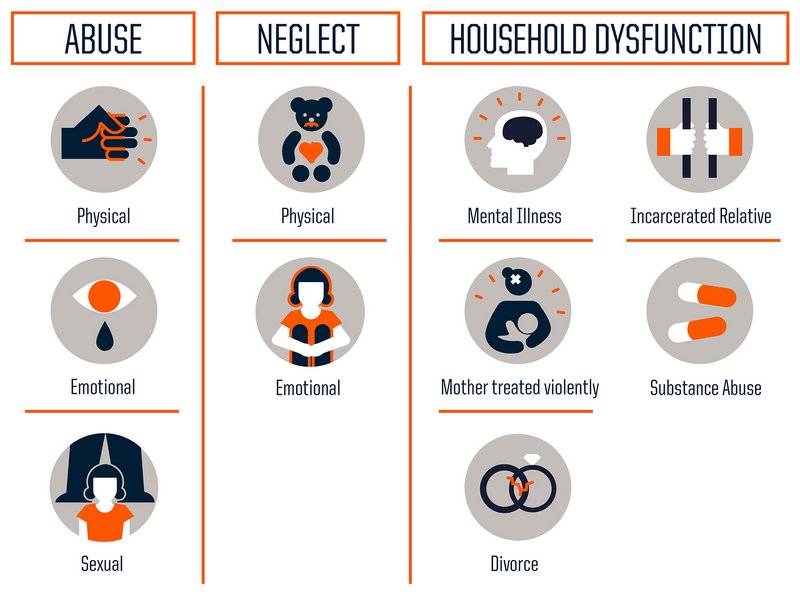

Source: Centers for Disease Control and Prevention
Credit: Robert Wood Johnson Foundation


How best to find and help kids who are experiencing abuse and neglect right now?

Child psychologist Hilit Kletter, of Stanford University's School of Medicine, says that to spot these children, she looks for visible signs of stress to understand what might have happened to them and how best to intervene. Some kids have nightmares or recurring thoughts of a stressful event, she says, or may re-enact the trauma through play. Or the child may seem distracted or withdrawn.

"This will come out at school," Kletter says. "Teachers will tell parents [their child] seems to be in a daze in the classroom, not paying attention."

ACEs Increase Health Risks

According to the Adverse Childhood Experiences study, the rougher your childhood, the higher your score is likely to be and the higher your risk for various health problems later.
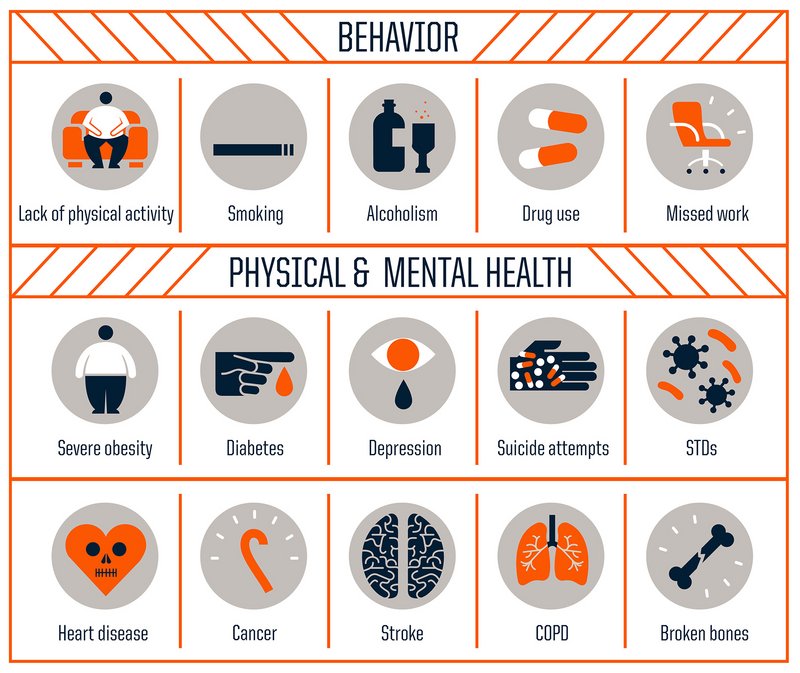

Source: Centers for Disease Control and Prevention
Credit: Robert Wood Johnson Foundation


Kletter says reactions to trauma are sometimes misdiagnosed as symptoms of attention deficit hyperactivity disorder, because kids dealing with adverse experiences may be impulsive — acting out with anger or other strong emotions.

"It's something that's very common in trauma: difficulty in regulating emotions and behavior," she explains. "That's why a lot of these kids get in trouble with the classroom."

Shonkoff's research center at Harvard tests interventions that can build resilience in kids who are growing up with adverse experiences — not just problems in the family, such as those the ACE study investigated, but also trauma stemming from poverty, for example, or from the chronic stress of racial or gender discrimination.

To bolster parents, the Harvard team is testing interventions right now that use video coaching to show moms and dads how to engage their babbling infants, using sounds and facial expressions in a style Shonkoff calls serve and return.

Shonkoff says these early interactions — a kind of conversation — have been shown to help children with later learning and literacy. Even more important, they boost kids' resilience, by helping them build secure attachments with caring adults. Research suggests that just one caring, safe relationship early in life gives any child a much better shot at growing up healthy.

https://www.npr.org/sections/health-...nd-doesnt-mean
Orema is offline   Reply With Quote
The Following 3 Users Say Thank You to Orema For This Useful Post:
Old 11-18-2021, 12:55 AM   #6
CherylNYC
Member

How Do You Identify?:
Stonefemme lesbian
Preferred Pronoun?:
I'm a woman. Behave accordingly.
Relationship Status:
Single, not looking.
 

Join Date: Jan 2010
Location: NYC
Posts: 1,467
Thanks: 9,474
Thanked 7,107 Times in 1,204 Posts
Rep Power: 21474853
CherylNYC Has the BEST ReputationCherylNYC Has the BEST ReputationCherylNYC Has the BEST ReputationCherylNYC Has the BEST ReputationCherylNYC Has the BEST ReputationCherylNYC Has the BEST ReputationCherylNYC Has the BEST ReputationCherylNYC Has the BEST ReputationCherylNYC Has the BEST ReputationCherylNYC Has the BEST ReputationCherylNYC Has the BEST Reputation
Default

Quote:
Originally Posted by Orema View Post
Take The ACE Quiz — And Learn What It Does And Doesn't Mean

March 2, 2015. 2:57 PM ET
LAURA STARECHESKI

An ACE score is a tally of different types of abuse, neglect, and other hallmarks of a rough childhood. According to the Adverse Childhood Experiences study, the rougher your childhood, the higher your score is likely to be and the higher your risk for later health problems. You can take the test here.

So, you've got your score. Now what?

First, remember that the ACE score isn't a crystal ball; it's just meant as guidance. It tells you about one type of risk factor among many. It doesn't directly take into account your diet or genes, or whether you smoke or drink excessively — to name just a few of the other major influences on health.

To learn more, check the CDC's ACE Study website. You'll find, among other things, a list of studies that explore the ways adverse childhood experiences have been linked to a variety of adult conditions, ranging from increased headaches to depression to heart disease.

Remember this, too: ACE scores don't tally the positive experiences in early life that can help build resilience and protect a child from the effects of trauma. Having a grandparent who loves you, a teacher who understands and believes in you, or a trusted friend you can confide in may mitigate the long-term effects of early trauma, psychologists say.

“There are people with high ACE scores who do remarkably well," says Jack Shonkoff, a pediatrician and director of the Center on the Developing Child at Harvard University.

Resilience, he says, builds throughout life, and close relationships are key. Recent research also suggests that for adults, "trauma informed" therapy — which can center on art, yoga or mindfulness training — can help.

Three Types of ACEs


Source: Centers for Disease Control and Prevention
Credit: Robert Wood Johnson Foundation


How best to find and help kids who are experiencing abuse and neglect right now?

Child psychologist Hilit Kletter, of Stanford University's School of Medicine, says that to spot these children, she looks for visible signs of stress to understand what might have happened to them and how best to intervene. Some kids have nightmares or recurring thoughts of a stressful event, she says, or may re-enact the trauma through play. Or the child may seem distracted or withdrawn.

"This will come out at school," Kletter says. "Teachers will tell parents [their child] seems to be in a daze in the classroom, not paying attention."

ACEs Increase Health Risks

According to the Adverse Childhood Experiences study, the rougher your childhood, the higher your score is likely to be and the higher your risk for various health problems later.


Source: Centers for Disease Control and Prevention
Credit: Robert Wood Johnson Foundation


Kletter says reactions to trauma are sometimes misdiagnosed as symptoms of attention deficit hyperactivity disorder, because kids dealing with adverse experiences may be impulsive — acting out with anger or other strong emotions.

"It's something that's very common in trauma: difficulty in regulating emotions and behavior," she explains. "That's why a lot of these kids get in trouble with the classroom."

Shonkoff's research center at Harvard tests interventions that can build resilience in kids who are growing up with adverse experiences — not just problems in the family, such as those the ACE study investigated, but also trauma stemming from poverty, for example, or from the chronic stress of racial or gender discrimination.

To bolster parents, the Harvard team is testing interventions right now that use video coaching to show moms and dads how to engage their babbling infants, using sounds and facial expressions in a style Shonkoff calls serve and return.

Shonkoff says these early interactions — a kind of conversation — have been shown to help children with later learning and literacy. Even more important, they boost kids' resilience, by helping them build secure attachments with caring adults. Research suggests that just one caring, safe relationship early in life gives any child a much better shot at growing up healthy.

https://www.npr.org/sections/health-...nd-doesnt-mean

Well, that was depressing.
__________________
Cheryl
CherylNYC is offline   Reply With Quote
The Following User Says Thank You to CherylNYC For This Useful Post:
Old 11-18-2021, 01:40 AM   #7
Orema
Superlative Soul Sister

How Do You Identify?:
Lesbian stone femme
Preferred Pronoun?:
She, her
Relationship Status:
Moving in a single file and sometimes a Sinner.
 
Orema's Avatar
 

Join Date: Dec 2013
Location: Cottage of Content
Posts: 14,067
Thanks: 41,614
Thanked 34,940 Times in 9,094 Posts
Rep Power: 21474863
Orema Has the BEST ReputationOrema Has the BEST ReputationOrema Has the BEST ReputationOrema Has the BEST ReputationOrema Has the BEST ReputationOrema Has the BEST ReputationOrema Has the BEST ReputationOrema Has the BEST ReputationOrema Has the BEST ReputationOrema Has the BEST ReputationOrema Has the BEST Reputation
Default

More on the ACE Scores.

https://americanspcc.org/take-the-aces-quiz/

The quiz score is based on ten types of childhood trauma measured in the ACE Study.

Five are personal — physical abuse, verbal abuse, sexual abuse, physical neglect, and emotional neglect.

Five are related to other family members: a parent who’s an alcoholic, a mother who’s a victim of domestic violence, a family member in jail, a family member diagnosed with a mental illness, and the disappearance of a parent through divorce, death or abandonment.

You get one point for each type of trauma. The higher your ACE score, the higher your risk of health and social problems.

As your ACE score increases, so does the risk of disease, social and emotional problems.

With an ACE score of 4 or more, things start getting serious. The likelihood of chronic pulmonary lung disease increases 390 percent; hepatitis, 240 percent; depression 460 percent; suicide, 1,220 percent.

The most important thing to remember is that the ACE score is meant as a guideline: If you experienced other types of toxic stress over months or years, then those would likely increase your risk of health consequences.
Fortunately, our brains and lives are somewhat plastic, which means our mental and physical health can improve. The appropriate integration of resilience factors born out of ACE concepts — such as asking for help, developing trusting relationships, forming a positive attitude, listening to feelings — can help people improve their lives.
____________________

And here’s a link to a Ted Talk by Dr. Nadine Burke Harris on how childhood trauma affects health across a lifetime.

https://www.youtube.com/watch?v=uXXTLf7oouU&t
Orema is offline   Reply With Quote
The Following 2 Users Say Thank You to Orema For This Useful Post:
Reply

Thread Tools
Display Modes

Posting Rules
You may not post new threads
You may not post replies
You may not post attachments
You may not edit your posts

BB code is On
Smilies are On
[IMG] code is On
HTML code is Off

Forum Jump


All times are GMT -6. The time now is 08:47 AM.


ButchFemmePlanet.com
All information copyright of BFP 2018