
|
|
|
 01-21-2012, 01:01 PM
|
#1 | |
|
Senior Member
How Do You Identify?:
Alpha Femme Preferred Pronoun?:
Goddess Relationship Status:
Completely in love Join Date: Nov 2009
Location: Southern Virginia
Posts: 3,225
Thanks: 2,564
Thanked 8,992 Times in 2,247 Posts
Rep Power: 21474856    |

Quote:
There are so many issues of control right now. I see the government pacifying and with elections looming they'll do just about anything. I have no faith in our government or its direction. I don't give a fuck who wins and it doesnt matter any more. They are all crooks. My best defense is to become fully independent and sustainable. To learn how to grow my own food, use less power (if any one day) because right now they are controlling it all and its going to get worse. I've never seen such a group of idiots in my entire life.
__________________
You either like me or you don't. It took me Twenty-something years to learn how to love myself, I don't have that kinda time to convince somebody else.
~ Daniel Franzese |
|

|

|
|
01-23-2012, 12:56 PM
|
#2 |
|
Senior Member
How Do You Identify?:
Butch Preferred Pronoun?:
she Relationship Status:
Truly Madly Deeply  Join Date: Aug 2011
Location: In My Head
Posts: 2,815
Thanks: 6,333
Thanked 10,401 Times in 2,477 Posts
Rep Power: 21474853 |
Occupy San Francisco Takes the Fight to Local Banks in Ambitious Next Step for Movement
After a brief hibernation, a refocused movement takes aim at corporate America--specifically, Wells Fargo and Bank of America on "Wall Street West." http://www.alternet.org/story/153849...t/?page=entire
__________________
The reason facts don’t change most people’s opinions is because most people don’t use facts to form their opinions. They use their opinions to form their “facts.” Neil Strauss |
|
|
|
| The Following 4 Users Say Thank You to Cin For This Useful Post: |
|
01-23-2012, 06:28 PM
|
#3 |
|
Senior Member
How Do You Identify?:
Butch Preferred Pronoun?:
she Relationship Status:
Truly Madly Deeply Join Date: Aug 2011
Location: In My Head
Posts: 2,815
Thanks: 6,333
Thanked 10,401 Times in 2,477 Posts
Rep Power: 21474853 |
The Corporate State Will Be Broken
Monday 23 January 2012 by: Chris Hedges I spent Friday morning sitting on a wooden bench in a fourth-floor courtroom in the New York Criminal Court in Manhattan. I was waiting to be sentenced for “disturbing the peace” and “refusing to obey a lawful order” during an Occupy demonstration in front of Goldman Sachs in November. Those sentenced before me constituted the usual fare of the court. They were poor people of color accused of mostly petty crimes—drug possession, thefts, shoplifting, trespassing because they were homeless and needed a place to sleep, inappropriate touching, grand larceny and violation of probation. They were escorted out of a backroom by a police officer, stood meekly before the judge with their hands cuffed behind them, were hastily defended by a lawyer clutching a few folders, and were sentenced. Ten days in jail. Sixty days in jail. Six months in jail. A steady stream of convictions. My sentence, by comparison, was slight. I was given an ACD, or “adjournment in contemplation of dismissal,” which means that if I am not arrested in the next six months my case is dismissed. If I am arrested during this period of informal probation the old charge will be added to the new one before I am sentenced. The country’s most egregious criminals, the ones who had stripped some of those being sentenced of their homes, their right to a decent education and health care, their jobs, their dignity and their hope, those wallowing in tens and hundreds of millions of dollars, those who had gamed the system to enrich themselves at our expense, were doing the dirty business of speculation in the tall office towers a few blocks away. They were making money. A few of these wealthy plutocrats were with the president, who was in New York that day to attend four fundraisers that took in an estimated $3 million. For $15,000 you could have joined Barack Obama at Daniel, an exclusive Upper East Side restaurant. For $35,000 you could have been at a gathering hosted by movie director Spike Lee. Most of those sentenced in that courtroom do not make that much in a year. It was a good day in New York for Barack Obama. It was a bad day for us. Our electoral system, already hostage to corporate money and corporate lobbyists, gasped its last two years ago. It died on Jan. 21, 2010, when the Supreme Court in Citizens United v. Federal Election Commission granted to corporations the right to spend unlimited amounts on independent political campaigns. The ruling turned politicians into corporate employees. If any politician steps out of line, dares to defy corporate demands, this ruling hands to our corporate overlords the ability to pump massive amounts of anonymous money into campaigns to make sure the wayward are defeated and silenced. Politicians like Obama are hostages. They jump when corporations say jump. They beg when corporations say beg. They hand corporations exemptions, subsidies, trillions in taxpayer money, no-bid contracts and massive loans with virtually no interest, and they abolish any regulations that impede profits and protect the citizen. Corporations like Goldman Sachs, because they own the system, are bailed out by federal dollars and given essentially free government loans to gamble. I am not sure what to call our economic system, but it is not capitalism. And if any elected official so much as murmurs anything that sounds like dissent, the Supreme Court ruling permits corporations to destroy him or her. And they do. Turn off your televisions. Ignore the Newt-Mitt-Rick-Barack reality show. It is as relevant to your life as the gossip on “Jersey Shore.” The real debate, the debate raised by the Occupy movement about inequality, corporate malfeasance, the destruction of the ecosystem, and the security and surveillance state, is the only debate that matters. You won’t hear it on the corporate-owned airwaves and cable networks, including MSNBC, which has become to the Democratic Party what Fox News is to the lunatic fringe of the Republican Party. You won’t hear it on NPR or PBS. You won’t read about it in our major newspapers. The issues that matter are being debated, however, on “Democracy Now!,” Link TV, The Real News, Occupy websites and Revolution Truth. They are being raised by journalists such as Glenn Greenwald and Matt Taibbi. You can find genuine ideas in corners of the Internet or in books by political philosophers such as Sheldon Wolin. But you have to go looking for them. Voting will not alter the corporate systems of power. Voting is an act of political theater. Voting in the United States is as futile and sterile as in the elections I covered as a reporter in dictatorships like Syria, Iran and Iraq. There were always opposition candidates offered up by these dictatorships. Give the people the illusion of choice. Throw up the pretense of debate. Let the power elite hold public celebrations to exalt the triumph of popular will. We can vote for Romney or Obama, but Goldman Sachs and ExxonMobil and Bank of America and the defense contractors always win. There is little difference between our electoral charade and the ones endured by the Syrians and Iranians. Do we really believe that Obama has, or ever had, any intention to change the culture in Washington? In this year’s presidential election I will vote for a third-party candidate, either the Green Party candidate or Rocky Anderson, assuming one of them makes it onto the ballot in New Jersey, but voting is nothing more than a brief chance to register our disgust with the corporate state. It will not alter the configurations of power. The campaign is not worth our emotional, physical or intellectual energy. Our efforts must be directed toward acts of civil disobedience, to chipping away, through nonviolent protest, at the pillars of established, corporate power. The corporate state is so unfair, so corrupt and so rotten that the institutions tasked with holding it up—the police, the press, the banking system, the civil service and the judiciary—have become vulnerable. It is becoming harder and harder for the corporations to convince its foot soldiers to hold the system in place. I sat a few days ago in a small Middle Eastern restaurant in Washington, D.C., with Kevin Zeese, one of the activists who first called for the Occupy movements. Zeese and others, including public health care advocate Dr. Margaret Flowers, set up the Occupy encampment on Freedom Plaza in Washington, D.C. They got a four-day permit last fall and used the time to create an infrastructure—a medic tent, a kitchen, a legal station and a press center—that would be there if the permit was not extended. The National Park Service did grant them an extended permit, and Freedom Plaza is one of the encampments that has not been shut down. “We do have a grand strategy,” he said. “Nonviolent movements shift power by attacking the columns that hold the power structure in place. Those columns are the military, police, media, business, workers, youth, faith groups, NGOs and civil servants. Every time we deal with the police, we have that in mind. The goal is not to hit them, hit them, hit them and weaken them. The goal is to pull people from those columns to our side. We want the police to know that we understand they’re not the 1 percent. The goal is not to get every police officer, but to get enough police so that you have a division.” “We do this with civil servants,” he went on. “We do whistle-blower events. We go to different federal agencies with protesters blowing whistles and usually with an actual whistle-blower. We hand out literature to the civil servants about how to blow the whistle safely, where they can get help if they do, why they should do it. We also try to get civil servants by pulling them to our side.” “One of the beautiful things about this security state is that they always know we’re coming,” he said. “It’s never a secret. We don’t do anything as a secret. The EPA, for example, sent out a security notice to all of its employees—advertising for us [by warning employees about a coming protest]. So you get the word out.” “Individuals become the media,” he said. “An iPhone becomes a live-stream TV. The social network becomes a media outlet. If a hundred of us work together and use our social networks for the same message we can reach as many people as the second-largest newspapers in town, The Washington Examiner or The Washington Times. If a thousand of us do, we can meet the circulation of The Washington Post. We can certainly reach the circulation of most cable news TV shows. The key is to recognize this power and weaken the media structure.” “We started an Occupy house in Mount Rainier in Maryland,” Zeese said. “Its focus is Occupy the Economy. This is the U.N.’s year of the co-op. We want to build on that. We want to start worker-owned co-ops and occupy our own co-ops. These co-ops will allow Occupiers to have resources so that they can continue occupying. It will allow them to get resources for the community. It will be an example to the public, a public where a high percentage of people are underemployed and unemployed although they have a lot of skills. People can band together in their community and solve a problem in the community. They can create a worker-owned collaborative of some kind. They can develop models of collective living.” “We looked at polling on seven key issues and found supermajorities of Americans—60-plus percent—were with us on issues including health care, retirement, energy, money in politics,” he said. “We are more mainstream than Congress. We aren’t crazy radicals. We are trying to do what the people want. This is participatory democracy versus oligarchy. It’s the elites versus the people. We stand with the majority.” The Washington encampment, like many Occupy encampments, has had to deal with those the wider society has discarded—the homeless, the mentally ill, the destitute and those whose lives have been devastated by substance abuse. This created a huge burden for the organizers, who decided that they were not equipped or able to deal with these wider, societal problems. The encampment in Washington’s Freedom Plaza enforces strict rules of behavior, including an insistence on sobriety, in order to endure through the winter and ensure its own survival. Other Occupy movements will have to do the same. “We don’t want to become a soup kitchen or a homeless shelter,” Zeese said. “We’re a political movement. These are problems beyond our ability. How do we deal with this? Let’s feed the Occupiers first, and those who are just squatting here for free get food last, so if we have enough food, we feed them. If we don’t, we can’t. We always fed people, of course. We usually have enough peanut butter and jelly sandwiches for everyone. But as we debated this issue, we stated talking about things like ‘how about a Freedom Plaza badge, or a Freedom Plaza wristband, or a Freedom Plaza card.’ None of those ideas were passed. What we ended up developing was a set of principles. Those principles included in them participation. You can’t be there because you want a [tent] or free food. You have to be there to build the community and the movement. You have to participate in the general assemblies.” “The first principles, of course, were nonviolence and non-property destruction,” he said. “We don’t accept violent language. When you’re violent you undermine everything. If the protesters in [Manhattan’s] Union Square, who were pepper-sprayed, had been throwing something at the police, you would not have had the movement. It was because they were nonviolent and didn’t react when they were being pepper-sprayed that the movement grew. At UC Davis, when those cops just walked down the line and sprayed, the nonviolent reaction by those kids was fantastic.” “We constantly kept hearing in the beginning what are our demands, what are our demands, is our demand to meet with Obama?” Zeese said. “We said: ‘Oh no, that would just be a waste. If we meet with Obama he’ll just get a picture opportunity out of that. We won’t get anything.’ You don’t make demands until you have power. If you make demands too soon, you don’t demand enough and you can’t enforce the demand that you get. So if you get promised an election, you can’t enforce that the ballots are counted right, for example. We realized late into our discussions—we had six months of planning, so four months into it—‘we don’t have the power to make a demand.’ That was very hard for a lot of our people to accept.” “Instead of making demands, we put up what we stood for, what principles we wanted to see,” he said. “The overarching demand was end corporate rule, shift power to the people. Once you make that as your demand, as your pinnacle, you can pick any issue—energy, health care, elections—and the solution becomes evident. For health care it’s get the insurance companies out from between doctors and patients; on finance it’s break up the big banks so that six banks don’t control 60 percent of the economy and break them up into community banks so that the money stays at home rather than going to Wall Street; energy is to diversify energy sources so people can build and have their own energy on their roof and become energy producers. The overarching goal was: End corporate rule, shift power to the people. We developed a slogan: ‘Human needs before corporate greed.’ After that, everything fell into place for us.” When the congressional super committee was meeting, the Occupy Washington movement formed its own super committee. The Occupy Super Committee, which managed get its hearing aired on CSPAN, included experts on the wealth divide, fair taxation, the military budget, job creation, health care and democratizing the economy as well as giving voice to the 99 percent. “The 99%’s Deficit Proposal: How to create jobs, reduce the wealth divide and control spending” resulted from the Occupy hearing. The report made evidence-based recommendations Zeese knew would not be considered by the Congress, but he saw it as foundational for the movement. “History shows the demands made by those in revolt are never initially considered by government,” he said. “Our job is to make the politically impossible the politically inevitable.” I do not know how long it will take to dethrone the corporate state, but I do know it is a dead and terminal system of power. As the global economy deteriorates and climate change causes greater disruptions, these corporations will be increasingly discredited. I know the iron grip of corporations over our lives will, eventually, be broken. The corporate state will, like all wounded animals, lash out with a blind fury, which is why I suspect we have been given the National Defense Authorization Act, which permits the military to arrest and hold U.S. citizens without due process. It will increase pressure to become crueler and more callous at the base of the columns it depends on for survival. And eventually it will break. No one knows how long this will take. It could be months, years, maybe even a decade, although the massive assault by the fossil fuel industry on the ecosystem will probably force a popular response sooner than we expect. The only question is how much damage these corporations will be permitted to inflict. I attended a rally Friday night in Foley Square, a few blocks from the criminal court where I had spent the morning. It was part of the Occupy the Courts event held across the nation to protest America’s corporate coup and the Supreme Court ruling in the Citizens United case. It was cold and blustery. Snow was on the way. Many in the crowd of a couple of hundred were visibly chilled. I spoke about the movement. I spoke about the lawsuit I have brought against Barack Obama and the secretary of defense to challenge the National Defense Authorization Act. I spoke about the inevitability of the Occupy movement. I realized, afterward, I had forgotten to say what was most important. I forgot to say thank you. Thank you for standing up to corporate power on a cold winter’s night. Thank you for making hope visible. You must never underestimate your power. I was sentenced in the day. I was exonerated in the night. http://www.truth-out.org/chris-hedge...ken/1327331237
__________________
The reason facts don’t change most people’s opinions is because most people don’t use facts to form their opinions. They use their opinions to form their “facts.” Neil Strauss |
|
|
|
|
01-26-2012, 12:18 AM
|
#4 |
|
Senior Member
How Do You Identify?:
Professional Sandbagger and Jenga Zumba Instructor Join Date: Sep 2011
Location: In the master control room of my world domination dreams
Posts: 2,811
Thanks: 6,587
Thanked 4,734 Times in 1,409 Posts
Rep Power: 21474852 |
From Moveon.org
Dear MoveOn Member,
Did you watch the State of the Union tonight? President Obama did exactly what hundreds of thousands of us have been calling on him to do—he announced a federal investigation into Wall Street. Here's what he said: "I am asking my Attorney General to create a special unit of federal prosecutors and leading state attorneys general to expand our investigations into the abusive lending and packaging of risky mortgages that led to the housing crisis. This new unit will hold accountable those who broke the law, speed assistance to homeowners, and help turn the page on an era of recklessness that hurt so many Americans." The best part is, progressive champion New York Attorney General Eric Schneiderman is co-chairing the investigation and will make sure it stays on track. Just weeks ago, this investigation wasn't even on the table, and the big banks were pushing for a broad settlement that would have made it impossible. Your work changed all that. This is truly a huge victory for the 99% movement. Hundreds of thousands of us signed petitions, made calls, and held signs outside in the cold to make this issue something that President Obama couldn't ignore. Here's some of what MoveOn members and our allies did to bring about this victory: - Over 360,000 of us signed a petition calling on President Obama to fully investigate the banks. - We delivered that petition at over 150 events last Thursday around the country at Obama for America campaign offices. - Our pressure on state attorneys general stopped the rush to a sweetheart deal that would have precluded this investigation. - And we've called, Facebooked, and tweeted at the White House repeatedly to ask the president to launch this investigation. Can you take a few minutes and thank President Obama for holding Wall Street accountable? Click here to post a message of thanks on the White House Facebook wall. Without an investigation, real accountability for the banks wouldn't be possible. But while this is a big win, it isn't enough all by itself. We still need to keep a close eye on the investigation, make sure top bankers don't escape prosecution, and keep fighting for real solutions for the 11 million underwater homeowners who are still struggling to keep their homes. |
|
|
|
| The Following 5 Users Say Thank You to SoNotHer For This Useful Post: |
|
01-27-2012, 01:33 PM
|
#5 |
|
Senior Member
How Do You Identify?:
Professional Sandbagger and Jenga Zumba Instructor Join Date: Sep 2011
Location: In the master control room of my world domination dreams
Posts: 2,811
Thanks: 6,587
Thanked 4,734 Times in 1,409 Posts
Rep Power: 21474852 |
From democracynow.org
Obama’s Late Payment to Mortgage-Fraud Victims.
By Amy Goodman with Denis Moynihan In his State of the Union address, many heard echoes of the Barack Obama of old, the presidential aspirant of 2007 and 2008. Among the populist pledges rolled out in the speech was tough talk against the too-big-to-fail banks that have funded his campaigns and for whom many of his key advisers have worked: “The rest of us are not bailing you out ever again,” he promised. President Obama also made a striking announcement, one that could have been written by the Occupy Wall Street General Assembly: “I’m asking my attorney general to create a special unit of federal prosecutors and leading state attorneys general to expand our investigations into the abusive lending and packaging of risky mortgages that led to the housing crisis. This new unit will hold accountable those who broke the law, speed assistance to homeowners and help turn the page on an era of recklessness that hurt so many Americans.” Remarkably, President Obama named New York Attorney General Eric Schneiderman as co-chairperson of the Unit on Mortgage Origination and Securitization Abuses. Schneiderman was on a team of state attorneys general negotiating a settlement with the nation’s five largest banks. He opposed the settlement as being too limited and offering overly generous immunity from future prosecution for financial fraud. For his outspoken consumer advocacy, he was kicked off the negotiating team. He withdrew his support of the settlement talks, along with several other key attorneys general, including California’s Kamala Harris, an Obama supporter, and Delaware’s Beau Biden, the vice president’s son. In an op-ed penned last November, Schneiderman and Biden wrote, “We recognized early this year that, though many public officials—including state attorneys general, members of Congress and the Obama administration—have delved into aspects of the bubble and crash, we needed a more comprehensive investigation before the financial institutions at the heart of the crisis are granted broad releases from liability.” When news of Schneiderman’s appointment surfaced, MoveOn.org sent an email to its members declaring: “Just weeks ago, this investigation wasn’t even on the table, and the big banks were pushing for a broad settlement that would have made it impossible. ... This is truly a huge victory for the 99 percent movement.” The stakes are very high for the public, and for President Obama. He relied heavily on Wall Street backers to fund his massive campaign war chest in 2008. Now, in this post-Citizens United era, with expected billion-dollar campaign budgets, Obama could find himself out of favor with Wall Street. For the public, as noted by the Center for Responsible Lending: “More than 20,000 new families face foreclosure each month, including a disproportionate percentage of African-American and Latino households. CRL research indicates that we are only about halfway through the crisis.” From http://www.democracynow.org/blog/201...by_amy_goodman |
|
|
|
| The Following 2 Users Say Thank You to SoNotHer For This Useful Post: |
|
01-29-2012, 02:33 AM
|
#6 |
|
Senior Member
How Do You Identify?:
Professional Sandbagger and Jenga Zumba Instructor Join Date: Sep 2011
Location: In the master control room of my world domination dreams
Posts: 2,811
Thanks: 6,587
Thanked 4,734 Times in 1,409 Posts
Rep Power: 21474852 |
Police clash with Oakland protesters, 100 held
By Laird Harrison | Reuters OAKLAND (Reuters) - Riot police arrested more than 100 anti-Wall Street protesters during a series of clashes in the streets of Oakland on Saturday that saw officers in riot gear firing tear gas at activists who tried to take over a shuttered convention center. Three officers were injured during the running confrontations, which police said first erupted when the crowd began destroying construction equipment and tearing down fencing at the Henry J. Kaiser Convention Center in downtown Oakland in the early afternoon. "Officers were pelted with bottles, metal pipe, rocks, spray cans, improvised explosive devices and burning flares," the Oakland Police Department said in a statement. "Oakland Police Department deployed smoke and tear gas." The scuffles marked the latest confrontation between police and Occupy activists seeking to regain lost momentum in their movement against economic inequality after authorities cleared protest camps across the country late last year. Occupy Oakland organizers had vowed to take over the fenced-off building to establish a new headquarters for their movement and draw attention to homelessness in a move seen as a challenge to authorities who have blocked similar efforts before. Police said 19 people were arrested near the convention center and another 100 taken into custody after they were corralled by officers outside a YMCA in downtown Oakland. "The one percent have all these empty buildings, and meanwhile there are all these homeless people," protester Omar Yassin told Reuters at the scene. Near the convention center, several dozen police officers declared an unlawful assembly and confronted the demonstrators at a fence, firing smoke and tear gas canisters into the crowd after telling protesters to disperse through loudspeakers. AMERICAN FLAG BURNS Some activists, carrying shields made of plastic garbage cans and corrugated metal, tried to circumvent the police line, and surged toward police on another side of the building as more smoke canisters were fired. "The City of Oakland welcomes peaceful forms of assembly and freedom of speech, but acts of violence, property destruction and overnight lodging will not be tolerated," police said in a statement. Later, hundreds of demonstrators regrouped and marched through downtown Oakland, where they were repeatedly confronted by police in riot gear. Police at several points fired flash-bang grenades into the crowd and swung batons at protesters. Later a group of demonstrators made their way to City Hall, where they brought out a U.S. flag and set it on fire before scattering ahead of advancing officers. Protesters in Oakland loosely affiliated with the Occupy Wall Street movement that began in New York last year have repeatedly clashed with police during a series of marches and demonstrations. In October, former U.S. Marine Scott Olsen was left in critical condition with a head injury following a confrontation with police on the streets of Oakland in which tear gas was deployed. Organizers said Olsen was struck in the head by a tear gas canister. Authorities opened an investigation into that incident but have not said how they believe he was hurt. Elsewhere, the National Park Service said on Friday it would bar Occupy protesters in the nation's capital, one of the few big cities where Occupy encampments survive, from camping in two parks where they have been living since October. That order, which takes effect on Monday, was seen as a blow to one of the highest-profile chapters of the movement. |
|
|
|
| The Following User Says Thank You to SoNotHer For This Useful Post: |
|
01-29-2012, 09:55 AM
|
#7 |
|
Senior Member
How Do You Identify?:
Professional Sandbagger and Jenga Zumba Instructor Join Date: Sep 2011
Location: In the master control room of my world domination dreams
Posts: 2,811
Thanks: 6,587
Thanked 4,734 Times in 1,409 Posts
Rep Power: 21474852 |
300 arrested in daylong Occupy Oakland protests
By TERRY COLLINS | Associated Press – 4 hrs ago OAKLAND, Calif. (AP) — Dozens of police maintained a late-night guard around City Hall following daylong protests that resulted in 300 arrests. Occupy Oakland demonstrators broke into the historic building and burned a U.S. flag, as officers earlier fired tear gas to disperse people throwing rocks and tearing down fencing at a convention center. Saturday's protests — the most turbulent since Oakland police forcefully dismantled an Occupy encampment in November — came just days after the group said it planned to use a vacant building as a social center and political hub and threatened to try to shut down the port, occupy the airport and take over City Hall. An exasperated Mayor Jean Quan, who faced heavy criticism for the police action last fall, called on the Occupy movement to "stop using Oakland as its playground." "People in the community and people in the Occupy movement have to stop making excuses for this behavior," Quan said. Protesters clashed with police throughout the day, at times throwing rocks, bottles and other objects at officers. And police responded by deploying smoke, tear gas and bean bag rounds, City Administrator Deanna Santanta said. Interim Police Chief Howard Jordan said about 300 arrests were made. "These demonstrators stated their intention was to provoke officers and engage in illegal activity and that's exactly what has occurred today," Santana said. The group assembled outside City Hall late Saturday morning and marched through the streets, disrupting traffic as they threatened to take over the vacant Henry Kaiser Convention Center. The protesters walked to the vacant convention center, where some started tearing down perimeter fencing and "destroying construction equipment" shortly before 3 p.m., police said. Police said they issued a dispersal order and used smoke and tear gas after some protesters pelted them with bottles, rocks, burning flares and other objects. The number of demonstrators swelled as the day wore on, with afternoon estimates ranging from about 1,000 to 2,000 people. A majority of the arrests came after police took scores of protesters into custody as they marched through the city's downtown, with some entering a YMCA building, said Sgt. Jeff Thomason, a police spokesman. Quan said that at one point, many protesters forced their way into City Hall, where they burned flags, broke an electrical box and damaged several art structures, including a recycled art exhibit created by children. She blamed the destruction on a small "very radical, violent" splinter group within Occupy Oakland. "This is not a situation where we had a 1,000 peaceful people and a few violent people. If you look at what's happening today in terms of destructing property, throwing at and charging the police, it's almost like they are begging for attention and hoping that the police will make an error." Dozens of officers surrounded City Hall, while others swept the inside of the building looking for protesters who had broken into the building, then ran out of the building with American flags before officers arrived. The protest group issued an email criticizing police, saying "Occupy Oakland's building occupation, an act of constitutionally protected civil disobedience was disrupted by a brutal police response today." Michael Davis, 32, who is originally from Ohio and was in the Occupy movement in Cincinnati, said Saturday was a very hectic day that originally started off calm but escalated when police began using "flash bangs, tear gas, smoke grenades and bean bags." "What could've been handled differently is the way the Oakland police came at us," Davis said. "We were peaceful." City leaders joined Quan in criticizing the protesters. "City Hall is closed for the weekend. There is no excuse for behavior we've witnessed this evening," City Council President Larry Reid said during a news briefing Saturday. Oakland Councilman Ignacio De La Fuente, echoed Reid's sentiments and said that what was going on amounts to "domestic terrorism." The national Occupy Wall Street movement, which denounces corporate excess and economic inequality, began in New York City in the fall but has been largely dormant lately. Oakland, New York and Los Angeles were among the cities with the largest and most vocal Occupy protests early on. The demonstrations ebbed after those cities used force to move out hundreds of demonstrators who had set up tent cities. In Oakland, the police department received heavy criticism for using force to break up earlier protests. Quan was among the critics, but on Saturday, she seemed to have changed her tune. "Our officers have been very measured," Quan said. "Were there some mistakes made? There may be. I would say the Oakland police and our allies, so far a small percentage of mistakes. "But quite frankly, a majority of protesters who were charging the police were clearly not being peaceful. Earlier this month, a court-appointed monitor submitted a report to a federal judge that included "serious concerns" about the department's handling of the Occupy protests. Jordan said late Saturday that he was in "close contact" with the federal monitor during the protests. Quan added, "If the demonstrators think that because we are working more closely with the monitor now that we won't do what we have to do to uphold the law and try keep people safe in this city, they're wrong." 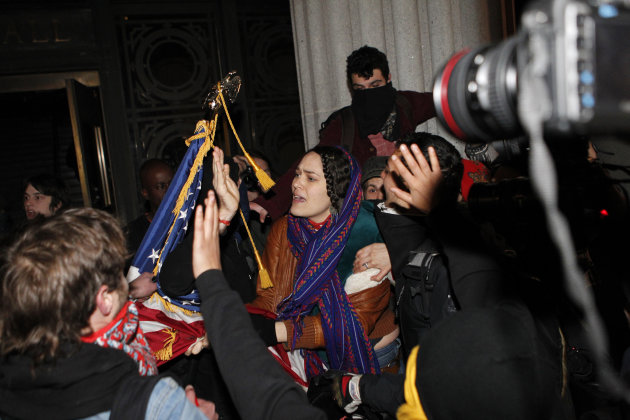
|
|
|
|
 |
|
|


 Hybrid Mode
