
|
|
|
 12-15-2012, 06:09 PM
|
#1 |
|
MILLION $$$ PUSSY
How Do You Identify?:
Kinky, Raw, Perverted, Uber Queer Alpha Femme Preferred Pronoun?:
Iconic Ms. Relationship Status:
Keeper of 3, only one has the map to my freckles 
Join Date: Nov 2009
Location: ** La Reina del Sur**
Posts: 22,488
Thanks: 32,231
Thanked 80,076 Times in 15,669 Posts
Rep Power: 21474875   |
 May They NEVER Be Forgotten
Charlotte Bacon, 6, Daniel Barden, 7, Olivia Engel, 6, Josephine Gay, 7, Ana M. Marquez-Greene, 6, Dylan Hockley, 6, Madeleine F. Hsu, 6, Catherine V. Hubbard, 6, Chase Kowalski, 7, Jesse Lewis, 6, James Mattioli, 6, Grace McDonnell, 7, Emilie Parker, 6, Jack Pinto, 6, Noah Pozner, 6, Caroline Previdi, 6, Jessica Rekos, 6, Avielle Richman, 6, Benjamin Wheeler, 6, Allison N. Wyatt, 6.
Rachel Davino, 29, Dawn Hochsprung, 47, Anne Marie Murphy, 52, Lauren Rousseau, 30, Mary Sherlach, 56, Victoria Soto, 27. __________________ 
__________________
"If you’re going to play these dirty games of ours, then you might as well indulge completely. It’s all about turning back into an animal and that’s the beauty of it. Place your guilt on the sidewalk and take a blow torch to it (guilt is usually worthless anyway). Be perverted, be filthy, do things that mannered people shouldn’t do. If you’re going to be gross then go for it and don’t wimp out."---Master Aiden   |

|

|
|
12-17-2012, 07:02 AM
|
#2 |
|
Infamous Member
How Do You Identify?:
Biological female. Lesbian. Relationship Status:
Happy  Join Date: Feb 2010
Location: Hanging out in the Atlantic.
Posts: 9,234
Thanks: 9,840
Thanked 34,611 Times in 7,637 Posts
Rep Power: 21474860 |
 Jack Hanlon, actor in Our Gang films
Jack Hanlon, who had roles in the 1926 silent classic "The General" and in two 1927 "Our Gang" comedies, died Thursday in Las Vegas. After a small role with Buster Keaton in "The General," he played mischievous kids in two of Hal Roach's "Our Gang/Little Rascals" films: "The Glorious Fourth" and "Olympic Games." Hanlon also played an orphan in the 1929 drama "The Shakedown," and got an on-screen kiss from Greta Garbo in the 1930 film "Romance." He appeared in eight more "talkies," including "Big Money" with Clark Gable, in the 1930s before calling it a career at the age of 16. He rarely made more than $5 a day.
__________________
|
|
|
|
|
12-17-2012, 06:44 PM
|
#3 |
|
Infamous Member
How Do You Identify?:
Biological female. Lesbian. Relationship Status:
Happy Join Date: Feb 2010
Location: Hanging out in the Atlantic.
Posts: 9,234
Thanks: 9,840
Thanked 34,611 Times in 7,637 Posts
Rep Power: 21474860 |
Sen. Daniel Inouye
 WASHINGTON (AP) — Sen. Daniel Inouye of Hawaii, the influential Democrat who broke racial barriers on Capitol Hill and played key roles in congressional investigations of the Watergate and Iran-Contra scandals, died Monday. He was 88. Inouye, a senator since January 1963, was currently the longest serving senator and was president pro tempore of the Senate, third in the line presidential succession. His office said Monday that he died of respiratory complications at a Washington-area hospital. Inouye was a World War II hero and Medal of Honor winner who lost an arm to a German hand grenade during a battle in Italy. He became the first Japanese-American to serve in Congress, when he was elected to the House in 1959, the year Hawaii became a state. He won election to the Senate three years later and served there longer than anyone in American history except Robert Byrd of West Virginia, who died in 2010 after 51 years in the Senate. After Byrd's death, Inouye became president pro tem of the Senate, a largely ceremonial post that also placed him in the line of succession to the presidency, after the vice president and the speaker of the House. Although tremendously popular in his home state, Inouye actively avoided the national spotlight until he was thrust into it. He was the keynote speaker at the 1968 Democratic National Convention, and later reluctantly joined the Senate's select committee on the Watergate scandal. The panel's investigation led to the resignation of President Richard Nixon. Inouye also served as chairman of the committee that investigated the Iran-Contra arms and money affair, which rocked Ronald Reagan's presidency. A quiet but powerful lawmaker, Inouye ran for Senate majority leader several times without success. He gained power as a member of the Senate Appropriations Committee and chairman of the defense appropriations subcommittee before Republicans took control of the Senate in 1994. When the Democrats regained control in the 2006 elections, Inouye became chairman of the Senate Commerce Committee. He left that post two years later to become chairman of the powerful Senate Appropriations Committee. Inouye also chaired the Senate Indian Affairs Committee for many years. He was made an honorary member of the Navajo nation and given the name "The Leader Who Has Returned With a Plan." In 2000, Inouye was one of 22 Asian-American World War II veterans who belatedly received the nation's top honor for bravery on the battlefield, the Medal of Honor. The junior senator from Hawaii at the time, Daniel Akaka, had worked for years to get officials to review records to determine if some soldiers had been denied the honor because of racial bias.
__________________
|
|
|
|
|
12-20-2012, 06:55 AM
|
#4 |
|
Infamous Member
How Do You Identify?:
Biological female. Lesbian. Relationship Status:
Happy Join Date: Feb 2010
Location: Hanging out in the Atlantic.
Posts: 9,234
Thanks: 9,840
Thanked 34,611 Times in 7,637 Posts
Rep Power: 21474860 |
Conservative U.S. jurist Robert Bork dies at 85
WASHINGTON (Reuters) - Robert Bork, an American symbol of conservative judicial activism who played pivotal roles in Washington dramas around the Supreme Court and Watergate and whose name became a verb, died on Wednesday at age 85.
Nominated to the U.S. Supreme Court by Republican President Ronald Reagan in 1987, Bork was rejected by the Democratic-led U.S. Senate over his conservative judicial philosophy. He became a potent symbol to conservatives. "To bork" was added to the Oxford English Dictionary in 2002 with the definition, "To defame or vilify (a person) systematically, especially in the mass media, usually with the aim of preventing his or her appointment to public office; to obstruct or thwart (a person) in this way." Bork was already known to Americans as a figure in the Watergate scandal - the man who carried out Richard Nixon's order to fire the special prosecutor in 1973's "Saturday Night Massacre" - when he was nominated to the Supreme Court. Within 45 minutes of his nomination on July 1, 1987, Massachusetts Democratic Senator Edward Kennedy took to the Senate floor to denounce him as a man who wanted to outlaw abortion, ban the teaching of evolution and revive racial segregation. Bork said not a line of the speech was accurate. After a fierce confirmation fight, the Senate in October rejected Bork 58-42, the largest margin of defeat for any Supreme Court nominee and a big loss for Reagan. JUDICIAL CONSERVATIVE Bork's judicial conservatism, and especially fears he might vote to overturn abortion rights, led liberal, civil rights and feminist groups to join ranks against him. They charged that the burly, goateed Bork, then a federal judge, held views too extreme for the highest court. They warned he might cast the decisive vote to overturn the court's 1973 abortion rights decision and endanger anti-segregation rulings of the 1950s and 1960S, despite Bork's assurances he would not disturb "settled law." His supporters saw a political witch hunt. In later court fights, they used memories of the Bork hearings to rally their conservative supporters. Like many other conservative justices - although more outspoken and in great recorded detail - Bork held that judges should interpret the law narrowly according to the "original intent" of the Constitution's framers rather than making new law, which they called judicial activism. At his confirmation hearings, Bork's long record of writings and decisions as an active jurist made him vulnerable to attack. Among the most controversial were his views that the Constitution contained no generalized right to privacy nor unlimited authorization of free speech. He did little to help himself in his testimony before the Senate Judiciary Committee, appearing cold and ideological. But he fired back at critics, denying he wanted to "turn back the clock" and saying he was the victim of a liberal public relations campaign that distorted his record. He admitted the White House was caught by surprise by the intense opposition and echoed complaints by conservatives that Reagan should have done more to fight for the nomination. Justice Anthony Kennedy ended up being confirmed to the court in February 1988. Bork's defeat for confirmation to the Supreme Court was "the decisive moment in politicizing the process of judicial selection," said Michael McConnell, a professor at Stanford Law School and a former federal judge who testified on Bork's behalf at the 1987 hearings. "The scurrilous attacks on his views and his character set a new low for the process, and has poisoned the atmosphere for judicial confirmations ever since." Bork was bitter for years afterward and conservatives regarded him as a martyr to liberal activism and unreason. Three months after the Senate quashed his nomination, Bork resigned as a judge on the U.S. Court of Appeals for the District of Columbia Circuit after six years of service and went into private law, scholarship and commentary, supporting conservative causes for years to come. One stint was as an "expert consultant" to television broadcasters covering the 1991 confirmation hearings for another controversial Supreme Court nominee, Clarence Thomas. Bork was also active in the background during the attempt the impeach President Bill Clinton in the late 1990s, lending his expertise and support to the impeachment process. Before his nomination debacle, Bork had been best known for the brief role he had played as U.S. solicitor general at the Justice Department in a notorious 1973 Watergate episode. He carried out Nixon's order to fire Watergate Special Prosecutor Archibald Cox, who was demanding the release of Oval Office tape recordings Nixon wanted kept secret. Bork's immediate superiors - Attorney General Elliott Richardson and his deputy - quit rather than fire Cox, stirring public outrage in what became known as "The Saturday Night Massacre." The backlash ultimately led to Nixon's resignation, under threat of impeachment, in August 1974. Bork later said he followed Nixon's order to prevent "massive resignations" at the Justice Department and restore order there. Bork remained outspoken on judicial nominations. In 2005, when President George W. Bush nominated White House counsel Harriet Miers to succeed retiring Supreme Court Justice Sandra Day O'Connor, Bork was a leader among conservatives in opposing Miers. In 2011, Republican presidential candidate Mitt Romney appointed Bork co-chair of his Judicial Advisory Committee, to advise the campaign on judicial nominations and legal policy questions.
__________________
|
|
|
|
|
12-24-2012, 01:24 PM
|
#5 |
|
Infamous Member
How Do You Identify?:
Biological female. Lesbian. Relationship Status:
Happy Join Date: Feb 2010
Location: Hanging out in the Atlantic.
Posts: 9,234
Thanks: 9,840
Thanked 34,611 Times in 7,637 Posts
Rep Power: 21474860 |
Ex-MLB player Ryan Freel 36 found dead
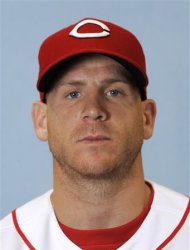 MIAMI (AP) -- Ryan Freel, a former Major League Baseball player known for his fearless play but whose career was cut short after eight seasons by a series of head and other injuries, was found dead Saturday in Jacksonville, Fla. Freel, who was 36, died of what appeared to be a self-inflicted shotgun wound. The speedy Freel spent six of his eight big league seasons with the Reds and finished his career in 2009 with a .268 average and 143 steals. The Jacksonville native thrilled fans with his all-out style, yet it took a toll on his career. During his playing days, he once estimated he had sustained up to 10 concussions. Freel missed 30 games in 2007 after a collision with a teammate caused a concussion. Freel showed no fear as he ran into walls, hurtled into the seats and crashed into other players trying to make catches. His jarring, diving grabs often made the highlight reels, and he was praised by those he played with and against for always having a dirt-stained uniform. Freel also had trouble related to alcohol.
__________________
|
|
|
|
|
12-24-2012, 05:46 PM
|
#6 |
|
Infamous Member
How Do You Identify?:
Biological female. Lesbian. Relationship Status:
Happy Join Date: Feb 2010
Location: Hanging out in the Atlantic.
Posts: 9,234
Thanks: 9,840
Thanked 34,611 Times in 7,637 Posts
Rep Power: 21474860 |
Jack Klugman dies
 LOS ANGELES (AP) — Jack Klugman, the prolific, craggy-faced character actor and regular guy who was loved by millions as the messy one in TV's "The Odd Couple" and the crime-fighting coroner in "Quincy, M.E.," died Monday. Never anyone's idea of a matinee idol, Klugman remained a popular star for decades simply by playing the type of man you could imagine running into at a bar or riding on a subway with — gruff, but down to earth, his tie stained and a little loose, a racing form under his arm, a cigar in hand during the days when smoking was permitted. His was a city actor ideal for "The Odd Couple," which ran from 1970 to 1975 and was based on Neil Simon's play about mismatched roommates, divorced New Yorkers who end up living together. The show teamed Klugman — the sloppy sports writer Oscar Madison — and Tony Randall — the fussy photographer Felix Unger — in the roles played by Walter Matthau and Art Carney on Broadway and Matthau and Jack Lemmon in the 1968 film. Klugman had already had a taste of the show when he replaced Matthau on Broadway and he learned to roll with the quick-thinking Randall, with whom he had worked in 1955 on the CBS series "Appointment with Adventure." In "Quincy, M.E.," which ran from 1976 to 1983, Klugman played an idealistic, tough-minded medical examiner who tussled with his boss by uncovering evidence of murder in cases where others saw natural causes. The son of Russian Jewish immigrants, he was born in Philadelphia and began his acting career in college drama (Carnegie Institute of Technology). After serving in the Army during World War I, he went on to summer stock and off-Broadway, rooming with fellow actor Charles Bronson as both looked for paying jobs. He made his Broadway debut in 1952 in a revival of "Golden Boy." His film credits included Sidney Lumet's "12 Angry Men" and Blake Edwards' "Days of Wine and Roses" and an early television highlight was appearing with Humphrey Bogart and Henry Fonda in a production of "The Petrified Forest." His performance in the classic 1959 musical "Gypsy" brought him a Tony nomination for best featured (supporting) actor in a musical. He also appeared in several episodes of "The Twilight Zone," including a memorable 1963 one in which he played a negligent father whose son is seriously wounded in Vietnam. His other TV shows included "The Defenders" and the soap opera "The Greatest Gift."
__________________
|
|
|
|
|
12-25-2012, 05:10 AM
|
#7 |
|
Infamous Member
How Do You Identify?:
Biological female. Lesbian. Relationship Status:
Happy Join Date: Feb 2010
Location: Hanging out in the Atlantic.
Posts: 9,234
Thanks: 9,840
Thanked 34,611 Times in 7,637 Posts
Rep Power: 21474860 |
Charles Durning
Charles Durning, the two-time Oscar nominee who was dubbed the king of the character actors for his skill in playing everything from a Nazi colonel to the pope, died Monday. He was 89. Durning may be best remembered by movie audiences for his Oscar-nominated, over-the-top role as a comically corrupt governor in 1982's "The Best Little Whorehouse in Texas." Durning received another Oscar nomination, for his portrayal of a bumbling Nazi officer in Mel Brooks' "To Be or Not to Be." He was also nominated for a Golden Globe as the harried police lieutenant in 1975's "Dog Day Afternoon." He won a Golden Globe as best supporting TV actor in 1991 for his portrayal of John "Honey Fitz" Fitzgerald in the TV film "The Kennedys of Massachusetts" and a Tony in 1990 as Big Daddy in the Broadway revival of "Cat on a Hot Tin Roof." He quickly made an impression on movie audiences the following year as the crooked cop stalking con men Paul Newman and Robert Redford in the Oscar-winning comedy "The Sting." Dozens of notable portrayals followed. He was the would-be suitor of Dustin Hoffman, posing as a female soap opera star in "Tootsie;" the infamous seller of frog legs in "The Muppet Movie;" and Chief Brandon in Warren Beatty's "Dick Tracy." He played Santa Claus in four different movies made for television and was the pope in the TV film "I Would be Called John: Pope John XXIII." Other films included "The Front Page," ''The Hindenburg," ''Breakheart Pass," ''North Dallas Forty," ''Starting Over," ''Tough Guys," ''Home for the Holidays," ''Spy Hard" and 'O Brother Where Art Thou?" Durning also did well in television as a featured performer as well as a guest star. He appeared in the short-lived series "The Cop and the Kid" (1975), "Eye to Eye" (1985) and "First Monday" (2002) as well as the four-season "Evening Shade" in the 1990s.
__________________
|
|
|
|
 |
|
|


 Hybrid Mode
